





Before working with couples, I always start with one individual session with each partner. These sessions are 50-minutes long, and they are much like a regular initial individual psychotherapy session.
While confidential, I explain that there are no secrets held within the individual sessions away from their partner. That means that anything discussed in the individual sessions can be brought up by either them or me in the subsequent couples sessions.
These two individual sessions allow for each client in a couple to express their perspectives of the couples dynamic and couples conflict and experience of what has been going on. They can also express what their individual goals are, one-on-one, with me.
Once the two individual sessions have taken place (i.e., one for each partner), we then move into the couples sessions, which are 80-minutes long. This additional length is to recognize that there are three of us in the session, and 50-minutes goes very quickly in such a context. In my approach, it is important that we have adequate time to explore matters without feeling rushed, while also not going so long as to exhaust ourselves.
How do you approach couples sessions?
In couples sessions, we can talk about anything, so long as both partners consent. This means we can talk about challenging and emotional content. Sometimes, this can include criticism by one partner regarding the other; however, abuse goes too far and is not permitted by me.
Couples therapy with me is largely based on a person-centered approach, although I do draw on other schools, for example, psychodynamic, solution-focused brief therapy and mindfulness-based. Within this person-centered system is an environment of unconditional positive regard from me. What this means is that my clients are given respect and care and that my positive regard for them is not conditional on them thinking or behaving as I might, for example (see Rogers, 2007). I may not necessarily agree, but that is not the point. As Carl Rogers described regarding unconditional positive regard, “It means a caring for the client as a separate person, with permission to have his own feelings, his own experiences” (Rogers, 2007, p. 243).
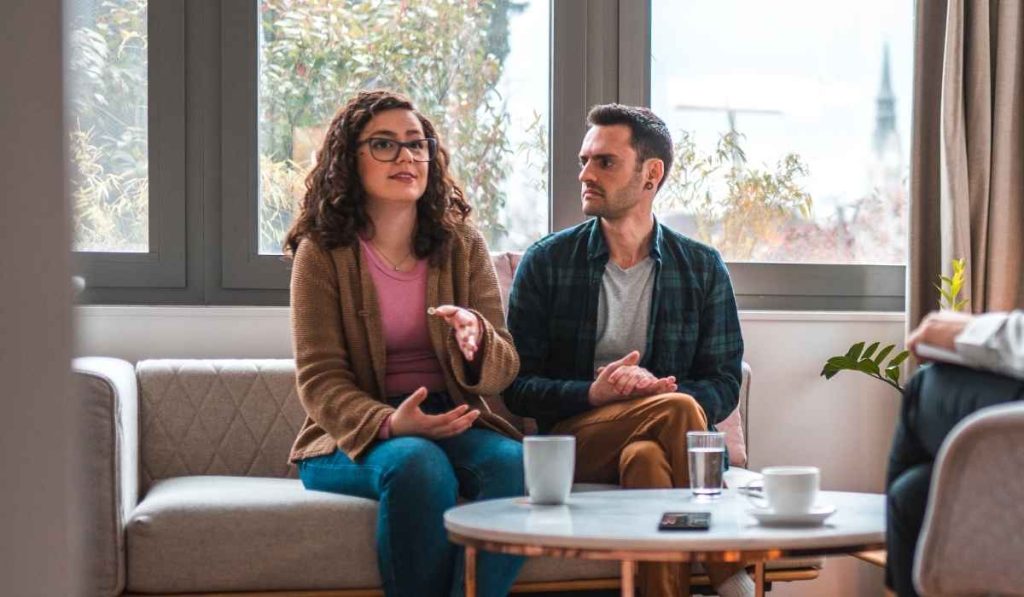
Importantly, within couples sessions, I work with clients to create an environment that encourages respect, empathy, curiosity and patience (see O’Leary, 2015). In these sessions, I take on three critical roles, (1) the moderator; (2) the host; and (3) the translator, basically as set-out and envisaged by O’Leary (2015) and discussed further down.
As moderator, I act as a kind of air traffic controller of ideas. Shifting back and forth between the partners in the couple during each session. Sometimes this means that I interrupt, but this is done to address opportunities, or where I notice that failing to interrupt will undermine some goal within the couples therapy. Space is made so that each of the partners can have a chance to express themselves. It is important for “people to be not only heard but to have time to be understood. Clients are equally asked to make space for their counter-parts to be understood” (O’Leary, 2015, p. 238).
My role as host comes from the fact that we are in my virtual therapy room, and couples therapy “is a place in which persons may have a different experience than they have at home” (O’Leary, 2015, p. 240). It is my sandbox, and I invite clients in for couples therapy sessions, and both partners are my guests, as it were. As O’Leary (2015) expressed, there is the opportunity for the therapist to inject “curiosity” (p. 241) into a relationship dynamic, and I aim to.
Finally, as a translator, I reformulate and repackage some of what clients are expressing within the session. It may be that clients have expressed similar things to one another privately or in other sessions, and yet, in that context, been unable to really understand one another. As O’Leary (2015) expressed, “Translation is a caring, creative process, giving attention to the meaning of the speaker and the emotional language that the listener can hear” (p. 239).
O’Leary (2015) went on to note that “The therapist cannot create connection between clients. Slow, careful, empathic translating can create space in which renewed connection can occur” (p. 240). Therefore, my role is not to create that connection per se, but rather, as moderator, host and translator, and through person-centered couples therapy and other approaches when needed, help create a climate that is fertile for rapprochement and greater communication. At the same time, I offer and explore tools, including communication tools, that may assist couples in better hearing and ultimately understanding one another.
If this resonates with you, I invite you to book an appointment or call 647-220-4709 / email matthewpittspsy@protonmail.com
References
O’Leary, C. J. (2015). Person-centered couple and family therapy: the effects of an extra beat of time. Person-Centered & Experiential Psychotherapies, 14(3), 236–247. http://dx.doi.org/10.1080/14779757.2015.1043393
Rogers, C. R. (2007). The necessary and sufficient conditions of therapeutic personality change. Psychotherapy: Theory, Research, Practice, Training, 44(3), 240–248. https://doi.org/10.1037/0033-3204.44.3.240
Please kindly note that any pictures are for illustrative purposes only. No actual clients, therapists or therapy sessions are shown. Confidentiality is taken very seriously. Bastion Therapy only offers virtual therapy.